
My obsession with the Zettelkasten note-taking system
- Julia Park

- Jan 10, 2023
- 3 min read
The Zettelkasten note-taking system has changed my life. It makes me really excited. Maybe it's a bit extreme, but I kind of think it would be great if it was taught in schools as required curriculum (joking...mostly).
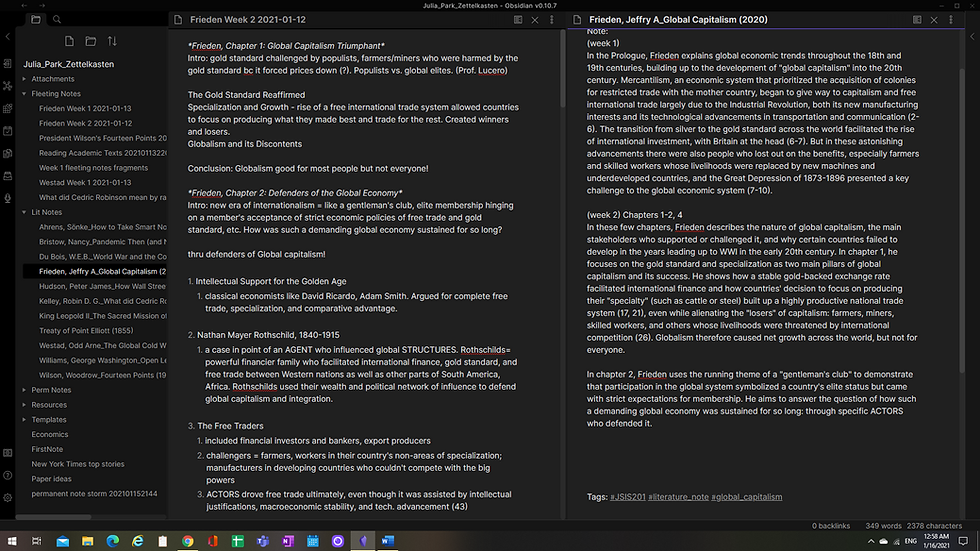
I first learned about the Zettelkasten system when I took ENGL 298: Intermediate Interdisciplinary Writing - Social Sciences, as a linked writing course with JSIS 201: Making of the 21st Century, in Winter 2021. It was for English Composition credit, and I had received an email about the course covering note-taking practices, which sounded more useful at that point in my academic career than the multimodal English comp course I had been planning on taking. So I decided to give it a shot. Best decision of my life!
Our graduate student instructor assigned us a book to read explaining the system: Sönke Ahrens' How to Take Smart Notes: One Simple Technique to Boost Writing, Learning and Thinking -- for Students, Academics and Nonfiction Book Writers. It is a concise and absolutely beautiful book in my opinion. No fluff or sophisticated tricks for note-taking, just a clear explanation of the Zettelkasten system (also called the slip-box because of the way it started out with physical notecards) and why it works.
So what is the Zettelkasten, you ask? Essentially, it is a system for organizing notes that is conducive to making connections between ideas and forcing you to actually THINK about what you're learning, not just copy down information. The way I learned it, notes are divided into fleeting, literature, and permanent notes. Fleeting notes are just basically your chicken-scratch thoughts on paper. They can be messy and make no sense as long as they're intelligible to you, and they're meant to be thrown away later after you use them as a reference to write your permanent notes. Permanent notes are basically a nicely-written, clear original idea that you elaborate on in a paragraph or so. They spring from making connections between previous notes and/or the reading or academic material you're studying, etc. Because writing permanent notes forces you to look back at your fleeting notes and think carefully about the connections that can be made, they're great prep for writing essays and written assignments, since you're essentially writing little chunks of good writing that could potentially find their way into your paper (edited, of course). Literature notes are just summaries of each text or source you read so that you have a record of what they're about. Ahrens' book does a great job of explaining the rest, as the system is rather complicated, but once you get the hang of it it is just wonderful. Our instructor taught us how to use Obsidian, a free software you can find online, to organize our Zettelkasten and create a sort of digital note system, as originally the system was designed for physical notecards and paper.
Now, I use the Zettelkasten in almost all of my classes. I'm not the best at updating it as regularly as I did in ENGL 298, but I'm definitely continuing to use it and the framework we learned, as well as other life-changing tips we learned about writing (the concept of "deep work," look for what interests you in a text because you'll naturally be motivated to study and explore your interests, etc).
Anyway, the Zettelkasten system and Obsidian (Zotero too) are amazing tools and it's not an understatement to say that they completely changed my college experience...give it a try if you ever get the chance!



Comments